Bali real estate has attracted a growing number of international investors since 2021, driven by 7 million international tourists in 2025 and net yields of 10 to 13% per year on well-positioned villas. Faced with this gold rush, many operators call themselves developers without a legal structure, without permits and without any real capacity to deliver a construction project. For a buyer based abroad, telling a genuine property developer in Bali apart from a mere agent or an improvised builder makes all the difference between a solid long-term asset and a project that goes off the rails. In this guide, I will walk you through how to evaluate a developer, the applicable legal framework, the real yields and the milestones of a turnkey project. On the ground, what we have observed over five years in Bali confirms one thing: the developer's rigor determines the final result.
Key takeaways
- A reliable developer in Bali operates through a PT PMA, handles the PBG/SLF permits in-house and stages payments against construction milestones.
- The real net yield of a well-positioned villa sits between 10 and 13% per year, after expenses, far from the 18-20% gross figures often advertised.
- A complete turnkey project takes 14 to 18 months for a 3-bedroom villa, with an entry ticket from 25.000 € through shared investment or 169.000 € for a solo villa.
Contents (6 chapters)
- 01What is a property developer in Bali?
- 02What legal framework for developers in Bali in 2026?
- 03How do you assess the reliability of a developer in Bali?
- 04What are the steps of a turnkey project in Bali?
- 05What real rental yields can a Bali villa deliver?
- 06What mistakes should you avoid with a developer in Bali?
What is a property developer in Bali?
In June 2024, the Bali real estate sector generated 142 million dollars in revenue in that single month, up 33% from the previous month (REID via OXO Living, 2024). This growth attracts improvised operators. A genuine property developer in Bali carries the project from A to Z: land sourcing, architectural design, permits, construction, delivery and often rental management.
The difference with a real estate agent (an intermediary broker) or a property trader (quick resale without construction) is structural. The developer commits its legal structure to the outcome. The agent collects a commission and moves on to the next deal. The builder executes plans without carrying the land tenure or the legal compliance.
What legal framework for developers in Bali in 2026?
Between 2022 and 2024, real estate transactions involving foreigners in Bali grew by 30% according to the BPN, which accelerated the legal structuring of the market. Three pillars frame the activity of a serious developer: the PT PMA (foreign-owned company), the choice between leasehold and freehold, and the PBG permits (formerly IMB) coupled with the SLF certificate of fitness for use.
A foreign investor accesses land through two main routes. The notarized leasehold offers a lease of 25 to 30 years, renewable. The PT PMA allows ownership under Hak Guna Bangunan or Hak Pakai, the functional equivalent of a freehold over 60 to 90 years. The PT PMA is the standard structure for operating a villa as a short-term rental.
A serious developer internalizes compliance: a partner notary, cadastral due diligence, RDTR zoning verification, permit filing before the construction site starts.
How do you assess the reliability of a developer in Bali?
Property prices in Bali have risen by an average of 7% per year over the past five years (REID via OXO Living, 2024). In a market that keeps appreciating, the developer's reliability directly protects the value of the asset. The selection checklist revolves around five concrete points.
First, a PT PMA number verifiable in the AHU.go.id registry, along with the NIB and the NPWP tax certificate. Second, a portfolio of delivered villas that can be physically visited, not just 3D renderings. Third, a transparent quote that separates land, construction, permits, furnishing and taxes. Fourth, a payment schedule tied to construction milestones. Never 100% at signing. Finally, documented remote site monitoring, with photos every two weeks and a post-delivery warranty.
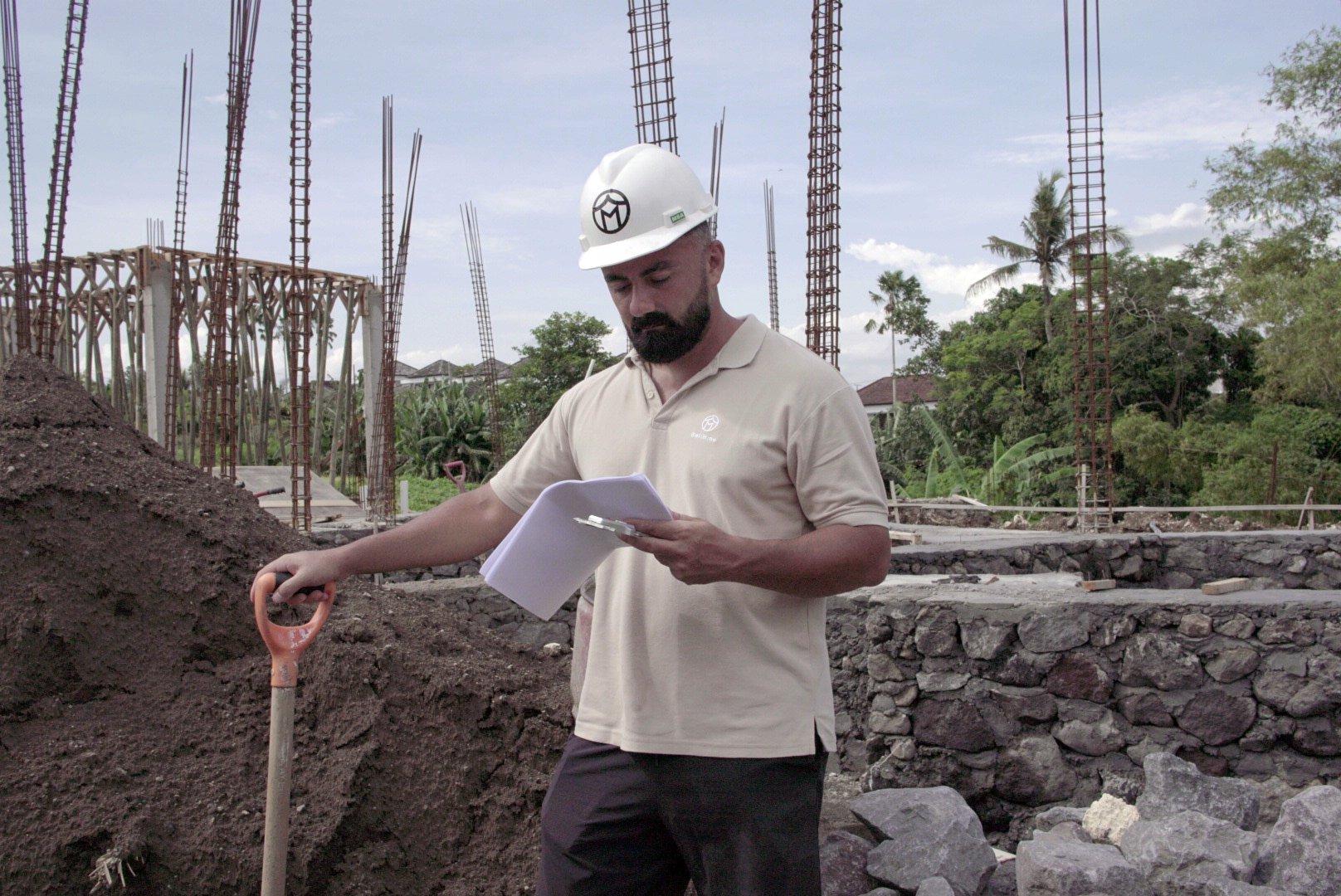
In practice, a solid developer readily agrees to a physical visit of an ongoing construction site and provides three reachable references from previous investors.
What are the steps of a turnkey project in Bali?
The realistic timeline of a turnkey villa project involves five successive phases. Land sourcing and due diligence: 1 to 2 months. PT PMA structuring and notarial process: 1 month in parallel. Architectural design and PBG permit: 2 to 3 months. Construction of a 3-bedroom villa: 12 to 13 months. Furnishing and rental management setup: 1 month. Total: 14 to 18 months depending on the complexity of the case.
The typical payment milestones follow the physical progress of the construction site: land deposit at the preliminary agreement, lease signing at the notary, start of structural work, secondary works, finishes, delivery with a handover report. This mechanism protects the investor. Disbursement stays aligned with the value created.
In practice, a developer who promises 8 months of total construction is either lying or hiding future defects. The right timeline protects quality.
Thinking about a project in Bali?
Our experts review your situation for free, with no commitment.
What real rental yields can a Bali villa deliver?
In 2025, Bali recorded 6,948,754 international arrivals, up nearly 10% year on year (BPS Bali via ANTARA News, 2026). This tourist demand supports rental yields, but the gap between advertised gross and real net remains considerable. The 15-20% gross yields being advertised systematically ignore several expense lines.
Rental management takes 15 to 20% of revenue. The PB1 tax adds 10% on nightly rates. Then come rental income tax, maintenance, pool service, internet, insurance and seasonal vacancy. The realistic NET yield sits between 8 and 13% depending on the area and the quality of management.
Premium areas such as Canggu and Seminyak deliver 8 to 10% net, with more expensive land but stable occupancy. Emerging areas (Pererenan, Seseh, Kedungu, Tabanan) go up to 13% net thanks to cheaper land and growing demand.

What mistakes should you avoid with a developer in Bali?
In 2024, property prices in Bali rose by 8% across the island (MyExpat, 2025). This increase creates pressure to sign quickly, which exposes buyers to non-compliant setups. The warning signs are precise.
First red flag: a developer without a PT PMA or one proposing ownership "through an Indonesian nominee". Second: a contract exclusively in Bahasa Indonesia without a certified bilingual translation. Third: full payment demanded before the construction site starts. Fourth: no PBG permit at the time of marketing. Fifth: land in a green zone (protected sawah) or a non-buildable red zone. Sixth: no contractual delivery guarantee.
On the investor side, the frequent mistakes remain the same: underestimating Indonesian taxation, neglecting RDTR cadastral due diligence, choosing the lowest price without checking references. The cheapest option almost always costs more in the end.
The deciding test: a serious developer deliberately slows down the signing pace to secure due diligence. An opportunistic operator pushes you to sign within the week.
Frequently asked questions
With prices rising an average of 7% per year over five years according to REID, the entry ticket keeps moving. A turnkey 2-3 bedroom villa starts from 169.000 €, up to 300.000 € for a comfortable 3-bedroom. Through Balimmo's shared investment mechanism, the ticket drops to 25.000 €. This opens access to the market without carrying the entire land cost alone. See our shared investment.
Yes, through two solid legal routes. Either a notarized leasehold of 25 to 30 years, renewable (around 70% of the Bali market), or ownership through a PT PMA under Hak Guna Bangunan offering 60 to 90 years with tacit renewal. Foreign transactions grew by 30% between 2022 and 2024 according to the BPN. A serious developer structures this ownership at the notary with full cadastral due diligence. Details on Balimmo legal management.
With the Balinese economy growing at 5.48% in 2024 according to Bank Indonesia, construction sites are running at full capacity. Building a 3-bedroom villa takes 12 to 13 months. Adding land sourcing, PBG permits and furnishing, the total turnkey timeline is 14 to 18 months, excluding seasonal monsoon disruptions. See the details of our architectural design service.
With 6.9 million foreign tourists in 2025 according to BPS Bali, rental demand remains strong. Canggu and Seminyak deliver a stable 8 to 10% net, with land at 600 €-830 €/m² in Canggu. Emerging areas (Pererenan, Seseh, Kedungu, Tabanan) go up to 13% net, thanks to cheaper land and growing demand for high-end villas with rice field views. Details on our villa management in Bali.
With a property market worth $142M in the single month of June 2024 according to REID, verification requests are multiplying. Ask for the PT PMA number (verifiable on AHU.go.id), the NIB, the NPWP tax certificate, the PBG permits of ongoing projects and at least three references of delivered villas that can be visited. A transparent developer provides these documents without hesitation before any commitment. Our complete investor guide details the checklist.
Conclusion
Choosing a property developer in Bali in 2026 rests on three verifiable pillars. Legal compliance first, with an active PT PMA, PBG/SLF permits in order and a documented notarial setup. Operational transparency next, with a line-by-line detailed quote, payment milestones tied to construction and a remote report every two weeks. Verifiable performance finally, with delivered villas that can be visited and documented net yields between 10 and 13% per year. With 6.9 million foreign tourists in 2025 and a market rising 7% per year over five years, Bali real estate remains one of the most active markets in Southeast Asia. The quality of the developer determines the entirety of the investment outcome. The selection cannot be delegated.